How to Solve Numberlink Puzzles: Rules and 7 Strategies for Students
Numberlink — known to many students as “Flow” — is a puzzle about drawing lines between matching numbers. Beginners often draw the shortest line between each pair and then get stuck. Good solvers think differently: they look for moves that are forced. This guide explains the rules and seven strategies you can teach explicitly, so that students solve by reasoning rather than trial and error.
- The rules
- Strategy 1 — Start at the edges
- Strategy 2 — Adjacent pairs and short links
- Strategy 3 — Follow forced moves
- Strategy 4 — No empty pockets
- Strategy 5 — Avoid U-turns and 2×2 blocks
- Strategy 6 — Lines that must hug the wall
- Strategy 7 — Work from both ends
- Teaching the strategies
- A worked example
- Practice plan for a month
- Checking a finished puzzle
- Why these strategies matter beyond puzzles
The rules
- Connect each pair of matching numbers with a single line.
- Lines move horizontally or vertically through the centres of squares.
- Lines never cross, branch or share a square.
- Every square of the grid must be filled by some line.
The last rule is what makes a well-made puzzle have exactly one solution. It also gives students a powerful checking tool: an empty square means something is wrong.
Strategy 1 — Start at the edges
Numbers on the border have fewer directions to move. A number in a corner has only two possible first moves, and often only one makes sense. Begin every puzzle by looking along the edges.
Strategy 2 — Adjacent pairs and short links
When two matching numbers sit next to each other, they are usually connected directly. Check first that this does not leave a square that nothing else can reach.
Strategy 3 — Follow forced moves
If a number (or the end of a line you are drawing) has only one empty neighbour, the line must go there. Keep following forced moves until there is a choice — you will be surprised how far this goes.
Strategy 4 — No empty pockets
Because every square must be used, never draw a line that cuts off a small area no other line can enter. If a one-square pocket appears, that move was wrong.
Strategy 5 — Avoid U-turns and 2×2 blocks
A line that makes a tight U-turn beside itself, or fills a 2×2 block, could almost always take a shortcut — which would leave squares empty. In a unique-solution puzzle these shapes rarely appear, so treat them as a warning sign.
Strategy 6 — Lines that must hug the wall
Long empty stretches along the border usually belong to a line that runs along the edge. Ask: “Which pair could possibly reach this corner?” Often only one can.
Strategy 7 — Work from both ends
Draw short forced segments from both numbers of a pair. The gap between them gets smaller, and the remaining path often becomes obvious.
Teaching the strategies
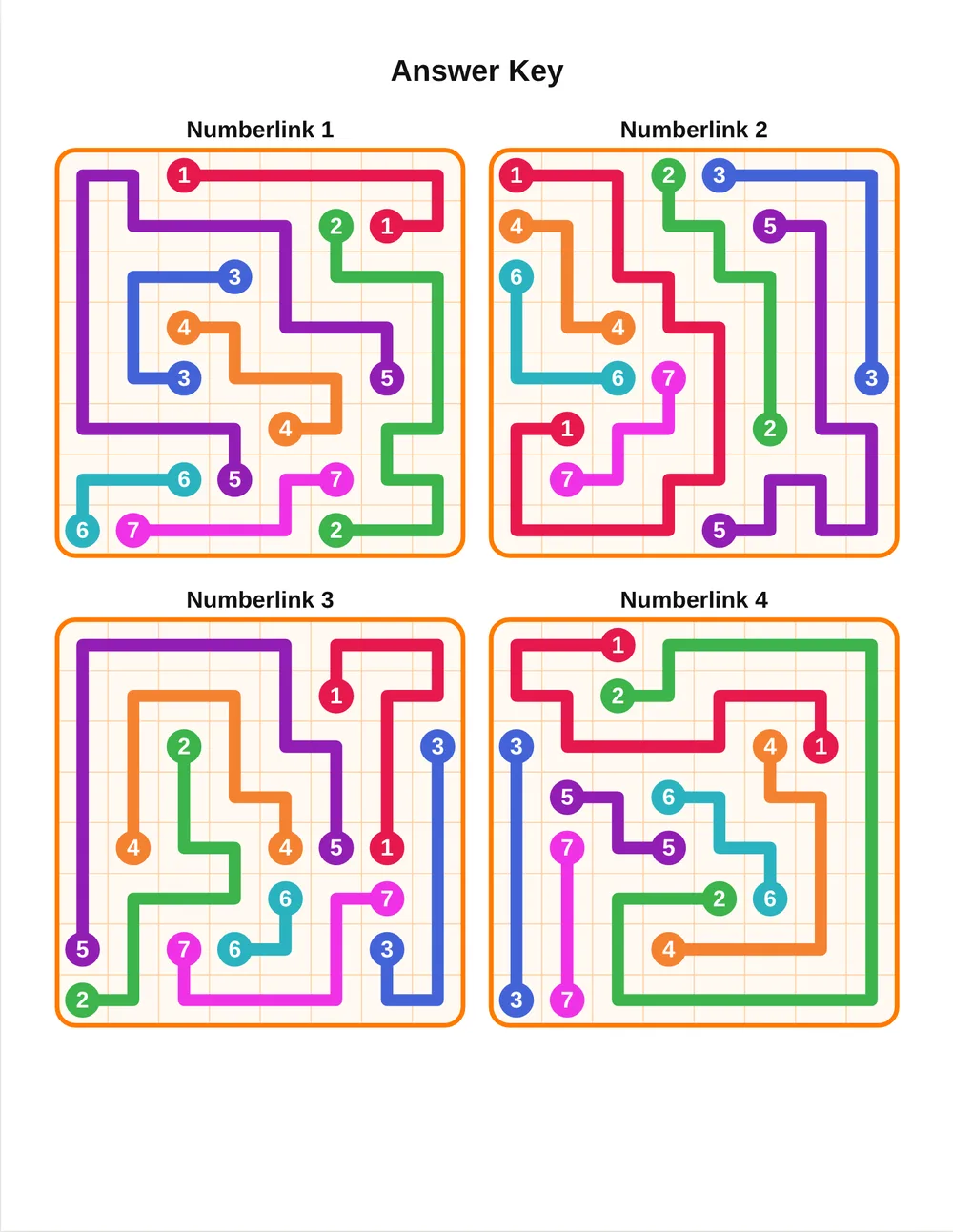
Introduce one strategy per session. Project a 6×6 or 7×7 puzzle, name the strategy, and ask students to find every move it forces before anyone draws a free choice. Then give a page of four puzzles at the same size. Ask students to mark forced moves in one color and choices in another — it makes their thinking visible and shows that good solving is mostly logic.
Progress through sizes: 5×5 and 6×6 Easy for learning the rules, 8×8 Medium for strategies, and 12×12 Hard once students can explain their moves. The Numberlink Puzzle Maker creates all of these with answer keys.
A worked example
Picture a 6×6 grid with a 1 in the top-left corner and another 1 two squares to its right. The corner 1 can move only right or down. Moving down would leave the square between the two 1s isolated, because no other pair can reach it without blocking the 1s — and every square must be used. So the line goes right, through the middle square, to the other 1. Next, a 2 sits just below the corner: its only free neighbours are below and to the right, and the square to the right is now the only way into the second row, so the 2 must turn right. Each move is forced by the rule that every square is filled — no guessing needed.
Practice plan for a month
- Week 1: 5×5 and 6×6 Easy — learn the rules and strategies 1–3.
- Week 2: 7×7 Easy to Medium — add strategies 4 and 5, mark forced moves in color.
- Week 3: 8×8 Medium — partner solving with justifications, strategies 6 and 7.
- Week 4: 10×10 or 12×12 Hard — independent challenge, students explain their hardest move.
Checking a finished puzzle
Before calling a puzzle solved, check three things: every pair is connected, no lines cross or touch inside a square, and no square is left empty. If one square is empty, a line somewhere took a shortcut — find the line next to the gap and reroute it.
Why these strategies matter beyond puzzles
“Look for what is forced”, “check what a move rules out” and “use the constraint that everything must be used” are the same habits that help students in geometry proofs, logic problems and multi-step word problems. Naming them in a puzzle context makes it easier to transfer them to mathematics. For more ideas see logic puzzles in math class.
Create your own puzzles in minutes
Unique solutions · answer keys · US Letter, A4 & KDP sizes · PDF, PNG, SVG, PPTX
Start your free day →Frequently asked questions
What are the rules of Numberlink?
Connect each pair of matching numbers with a line that moves horizontally or vertically, without crossing or branching, so that every square is used.
Is Numberlink the same as Flow?
Yes, Flow is a popular app version of the Numberlink puzzle.
Where should I start a Numberlink puzzle?
Start with numbers on the edges and corners, where lines have the fewest options.
Do Numberlink puzzles have one solution?
Well-made puzzles do. Puzzles from our Numberlink Puzzle Maker are checked to have exactly one solution.
Are Numberlink puzzles good for kids?
Yes. They build spatial reasoning, planning and perseverance, and small 5×5 grids suit children from about five years old.
Do all squares have to be filled?
In our puzzles, yes. Filling every square is part of the rules and guarantees a single solution.
Summary
Numberlink rewards reasoning over guessing: start at the edges, follow forced moves, never leave empty pockets and work from both ends. Teach one strategy at a time and students will solve bigger grids with confidence.
More puzzle guides for teachers
We build math worksheets, puzzle makers, answer keys and classroom tools for teachers, tutors and homeschool parents, and keep these guides up to date.