Tarsia Puzzles in Math: What They Are and How to Make Them for Your Students
A Tarsia puzzle is a jigsaw in which the pieces fit together only when every question is placed next to its answer. Students cut out triangles or squares, solve the problems on the edges and rebuild a big triangle, hexagon or square. It is a cut-and-match activity, a puzzle and a self-checking worksheet in one. This guide explains what Tarsia puzzles are, why they are so effective in maths lessons, and how to make printable Tarsia puzzles — pieces, student base board and teacher solution — with the Tarsia Puzzle Maker in your OnlineMathWorksheet account.
What is a Tarsia puzzle?
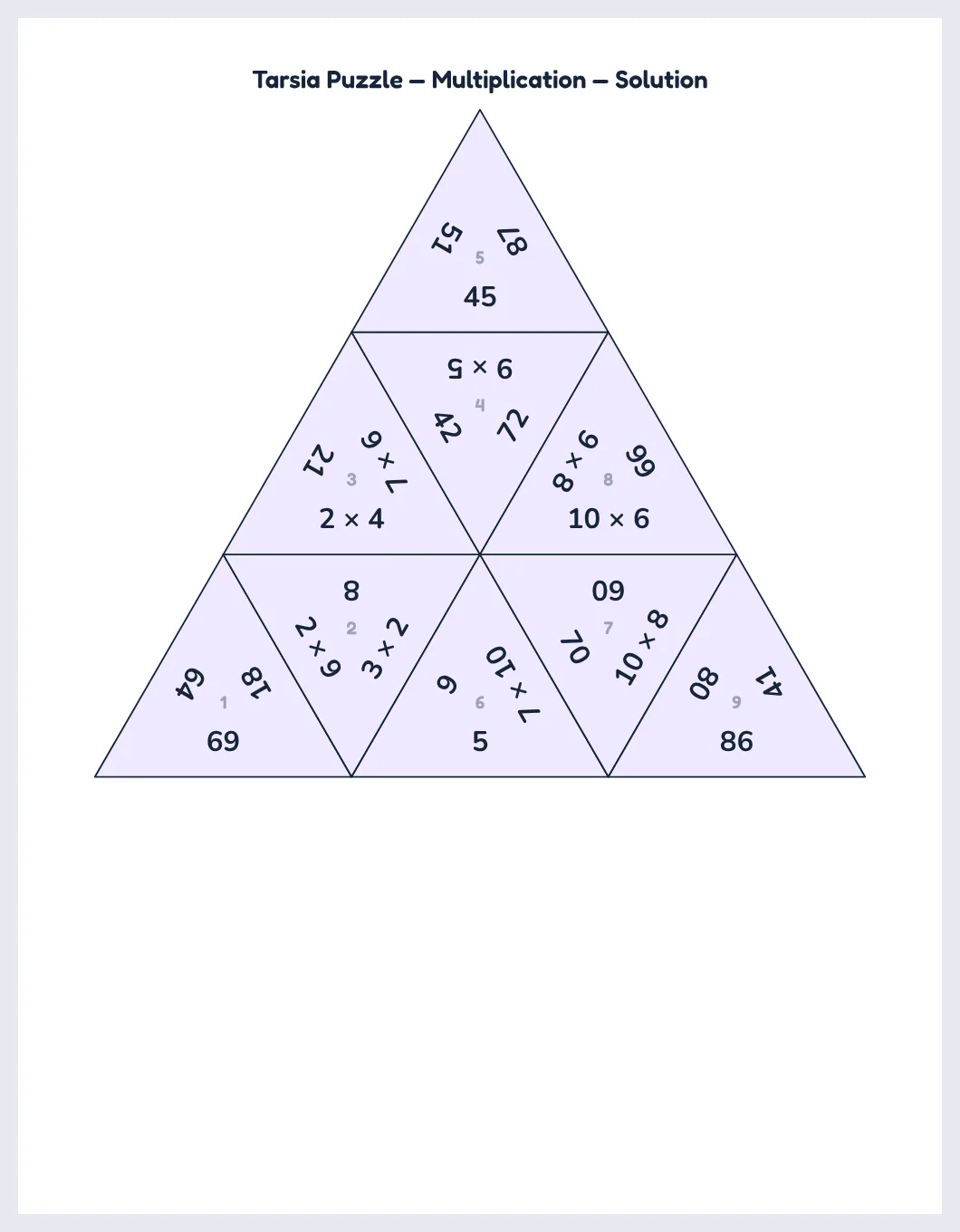
Tarsia puzzles are named after tarsia, the Italian art of wood inlay, where small pieces fit together to form a pattern. In a maths Tarsia puzzle, every inside edge of the finished shape has a question on one piece and the matching answer on the neighbouring piece — for example 6 × 8 on one triangle and 48 on the triangle next to it.
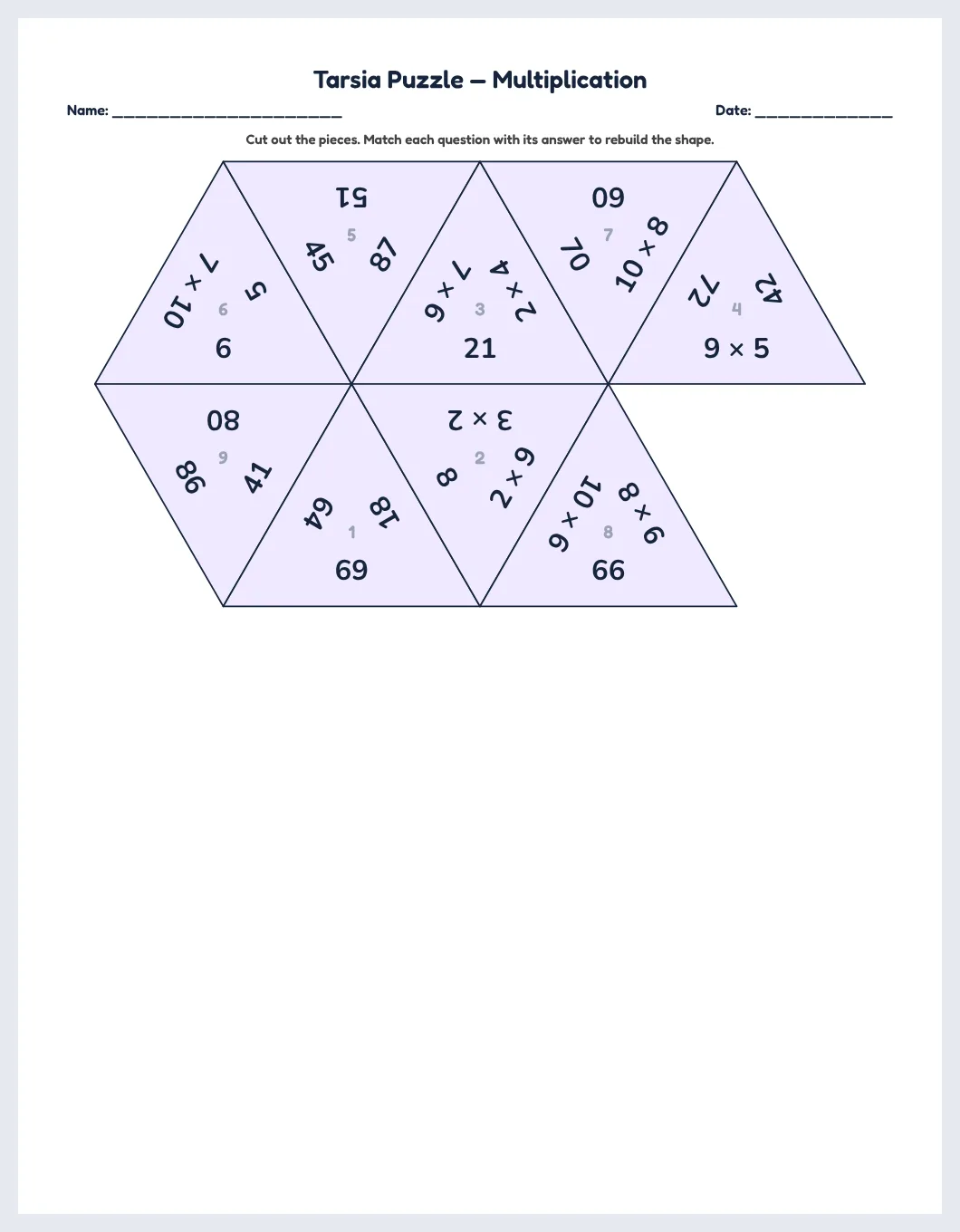
The pieces are printed in a shuffled order and rotated, so students cannot rely on the layout. They have to solve each problem and look for the piece that carries the answer. When every pair is matched, the shape is complete.
Why Tarsia puzzles work so well
- They are self-checking. If a match is wrong, pieces stop fitting later. Students find and fix their own mistakes.
- Every problem matters. One wrong pair blocks the puzzle, so students take care with each answer.
- Great for pairs and groups. Students discuss, test and justify: “It can’t go here, 7 × 6 is 42, not 48.”
- Distractors make students think. The outer edges can carry answers that match nothing, so guessing does not work.
- A hands-on change. Cutting, sorting and sticking gives a break from pencil-and-paper practice while keeping the maths at the centre.
The nine shapes and when to use them
| Triangle 4 · Hexagon 6 | 3 and 6 pairs — a first puzzle for young students or a 5-minute starter. |
|---|---|
| Square 9 · Triangle 9 | 12 and 9 pairs — the classic size for one lesson. |
| Rectangle 12 | 17 pairs — a good group activity. |
| Triangle 16 · Square 16 | 18 and 24 pairs — longer practice for confident classes. |
| Hexagon 24 · Triangle 25 | 30 and 30 pairs — a real challenge, ideal for revision lessons. |
How to make a Tarsia puzzle step by step
- Choose a shape from the nine icons.
- Choose a skill. The maker has 14: one more, one less, ten more, doubles, halves, addition, subtraction, addition and subtraction, multiplication, division, multiplication and division, square numbers, all four operations and equivalent fractions (for example 6/12 matches 1/2).
- Choose the range — a single times table, mixed tables up to 12, numbers up to 100, denominators up to 12…
- Outer edges: distractor answers or blank. For fractions, distractors are checked so that none is equal in value to a real answer.
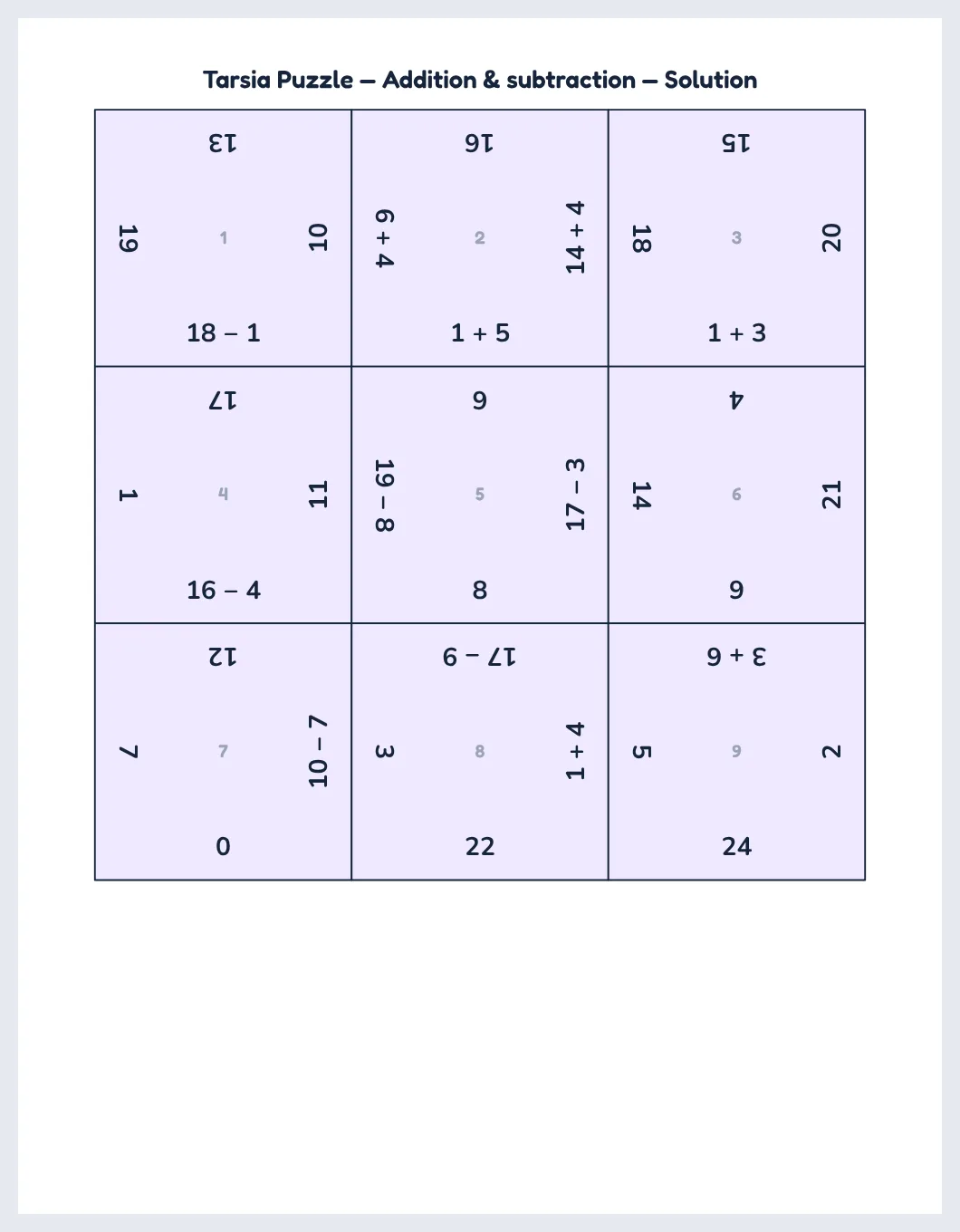
- Pages: the pieces page, the student base board and the teacher solution are created together.
- Export as PDF, PNG, SVG or PowerPoint.
Click 🎲 New puzzle for a fresh version with the same settings — useful when the class next door gets the same lesson.
Your own pairs for any topic
Choose Custom pairs and type one pair per line as question = answer. That turns the maker into a matching tool for anything: fractions and decimals (0.5 = 1/2), percentages (10% of 50 = 5), algebra (2x = 10 → x = 5), vocabulary, capitals or chemical symbols. The maker tells you how many pairs the chosen shape needs, and warns you if you have too few.
The student base board and teacher solution
The base board shows the outline of the finished shape with dashed lines, printed at the real size of the pieces, so students can stick each piece in place and hand in a finished poster. The teacher solution shows the completed puzzle. Small piece numbers can be printed on pieces and solution to make checking very quick; turn them off if you prefer.
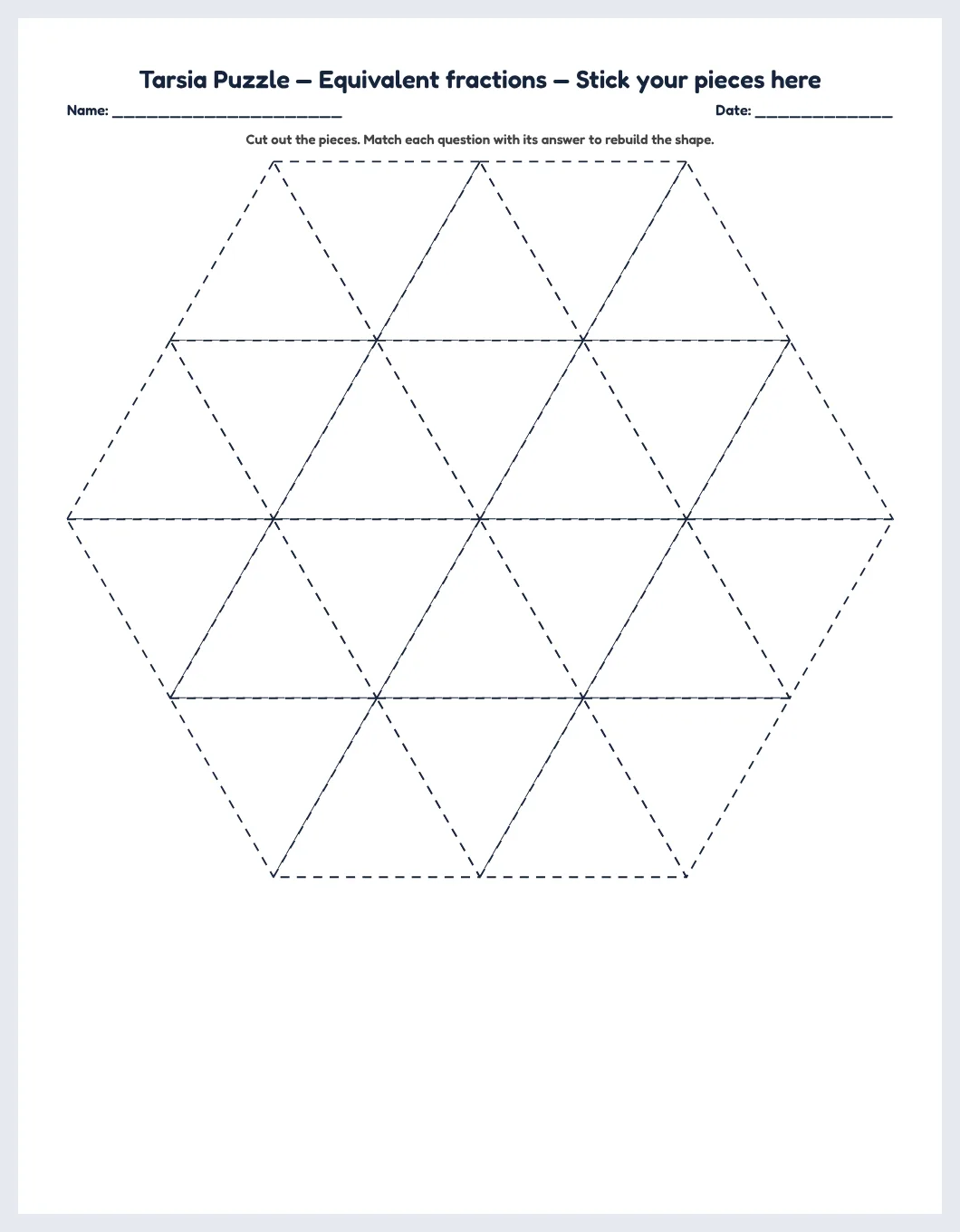
Design options
- Optional title, name line, date line and instructions, each with its own size.
- A font for the header and a font for the puzzle text.
- Piece size in centimetres (it shrinks automatically if the whole shape would not fit on one page), text size, 7 colours and white, soft or alternating fill.
- Cutting lines: solid, dashed or dotted, with thickness and colour.
- Page border: single or double, solid, dashed or dotted, with corner roundness, thickness, distance and colour.
- Up to 10 puzzles and 30 pages per project, plus one-click packs (times tables, grades 1–2, grades 3–4, fractions).
Classroom tips
- Start small: a 6-piece hexagon is perfect for the first time.
- Work in pairs: one student cuts while the other solves, then they swap.
- Envelope trick: keep each puzzle’s pieces in an envelope for reuse, or print on card.
- Ask for reasoning: students write two matches they were sure about and why.
- Extension: early finishers write their own pairs — then you type them into Custom pairs for the next lesson.
Make your own printable activities in minutes
Answer keys · US Letter, A4 & KDP sizes · PDF, PNG, SVG, PPTX
Start your free day →Frequently asked questions
What is a Tarsia puzzle in maths?
A jigsaw of triangles or squares in which each inside edge has a question on one piece and its answer on the neighbouring piece. Matching all pairs rebuilds the shape.
Where does the name Tarsia come from?
From tarsia, the Italian art of wood inlay, where small pieces fit together to form a pattern.
What shapes can I make?
Nine: triangles of 4, 9, 16 and 25 pieces, hexagons of 6 and 24, squares of 9 and 16, and a rectangle of 12.
Can I make Tarsia puzzles for fractions?
Yes. Choose Equivalent fractions: each question is an equivalent fraction (for example 6/12) and the answer is its simplest form (1/2).
What are distractors?
Answers on the outer edges of the shape that do not match anything. They stop students from guessing by shape alone.
Is there a solution page?
Yes, a teacher solution page and a student base board at real size are created for every puzzle.
Summary
Tarsia puzzles combine cutting, matching and problem solving in a self-checking activity. With the Tarsia Puzzle Maker you choose a shape and a skill — or type your own pairs — and get shuffled pieces, a real-size base board and a teacher solution ready to print.
More puzzle guides for teachers
We build math worksheets, puzzle makers, answer keys and classroom tools for teachers, tutors and homeschool parents, and keep these guides up to date.