33 Sudoku Variants Explained: Rules and Printable Examples
Once you know classic sudoku, a whole world of variants opens up. Each variant adds one extra rule — a diagonal, a cage, a line, a dot or a clue outside the grid — and that single rule changes how you think. Below are 33 variants with their rules in plain language and an example of each, grouped by type. Every example was created with the Sudoku Variety Studio, and every puzzle has exactly one solution.
Global rule variants
These variants add a rule that applies across the whole grid, without extra markings (or with simple shading).
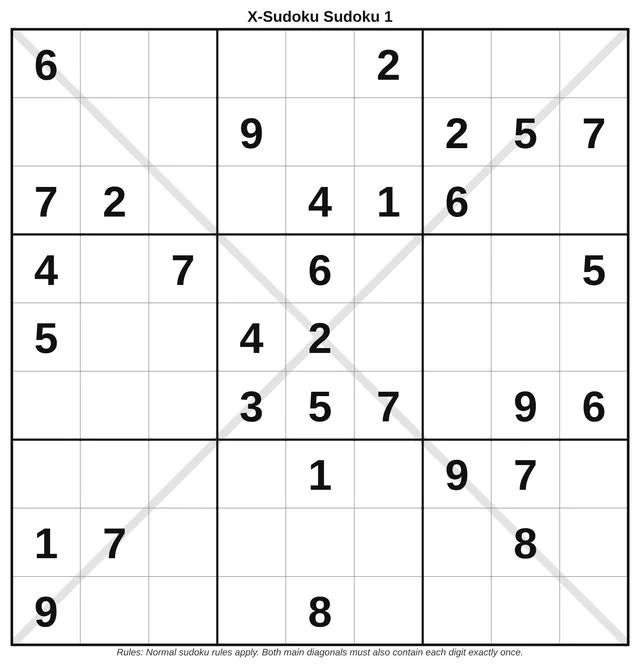
- X-Sudoku (Diagonal): both main diagonals also contain each digit once.
- Windoku (Hyper): four extra shaded 3×3 windows must contain 1–9.
- Anti-Knight: cells a chess knight’s move apart cannot hold the same digit.
- Anti-King: touching cells, even diagonally, cannot hold the same digit.
- Non-Consecutive: cells that share an edge cannot hold consecutive digits.
- Disjoint Groups: cells in the same position in every box form an extra group of 1–9.
- Even-Odd: grey squares hold even digits, circles hold odd digits.
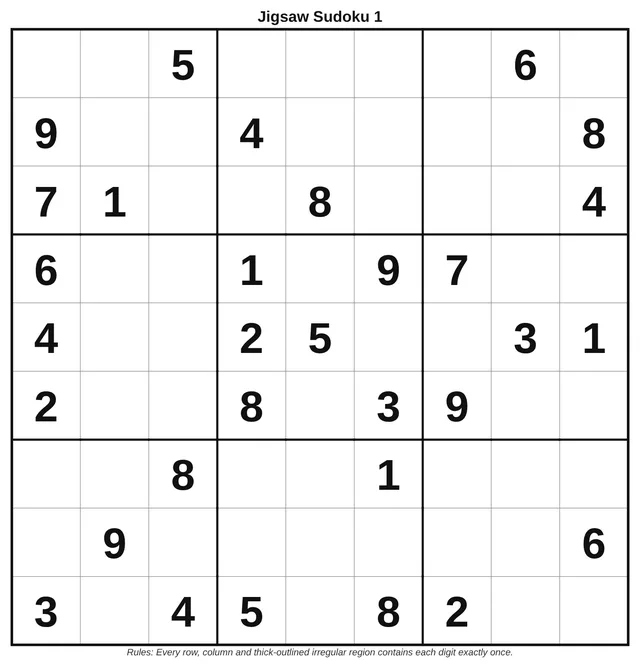
- Jigsaw (Irregular): the 3×3 boxes are replaced by irregular regions.
Cage variants
Killer sudoku covers the grid with dashed cages. Digits in a cage add up to the small sum and cannot repeat. It is the most popular variant after classic sudoku — see our killer sudoku guide for strategies.
Line variants
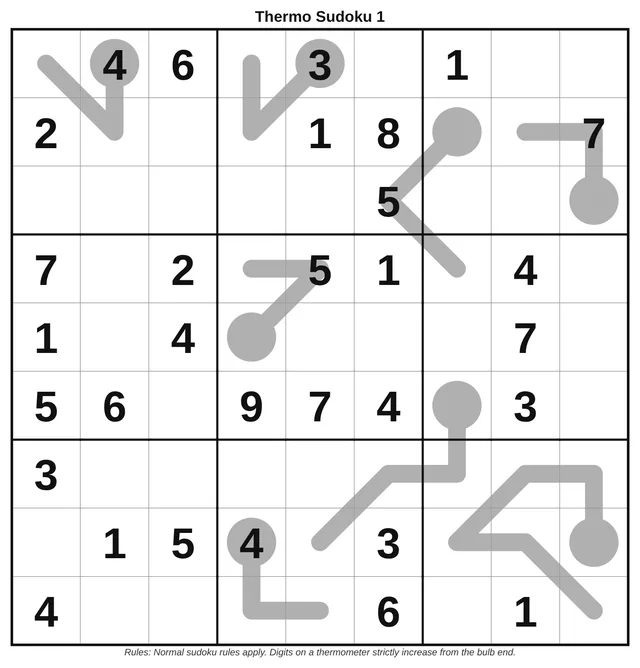
- Thermo: digits strictly increase from the bulb of the thermometer.
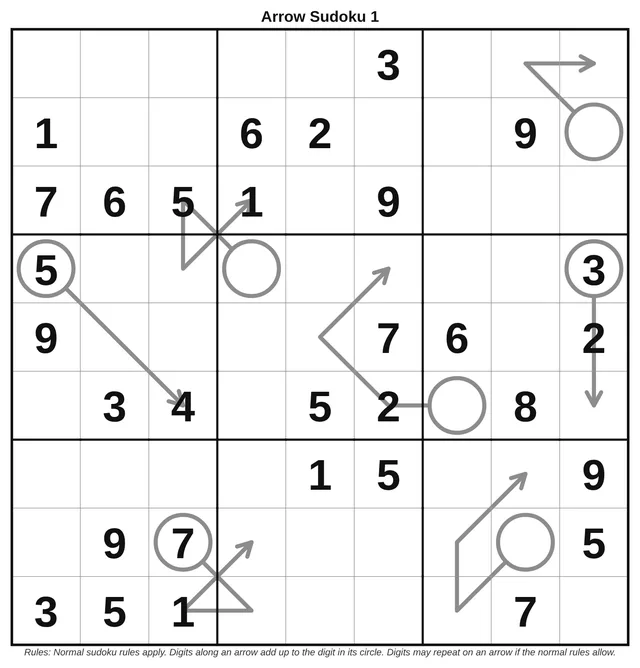
- Arrow: digits along an arrow add up to the digit in its circle.
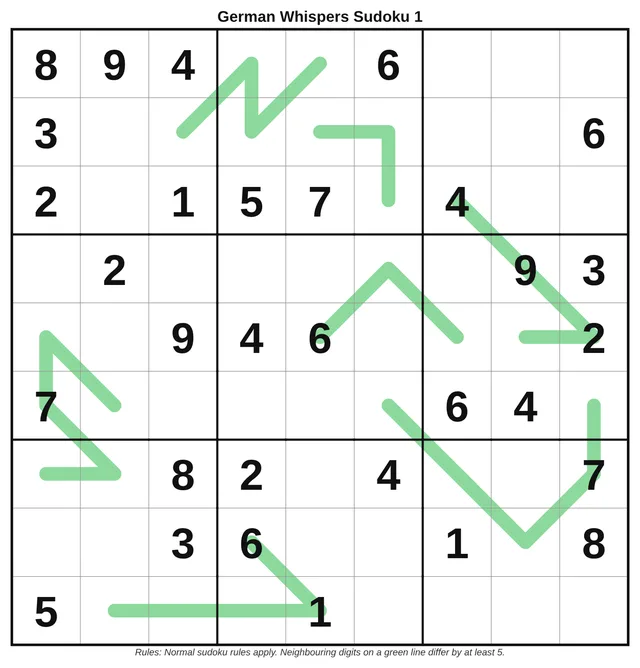
- German Whispers: neighbouring digits on a green line differ by at least 5.
- Dutch Whispers: neighbouring digits on an orange line differ by at least 4.
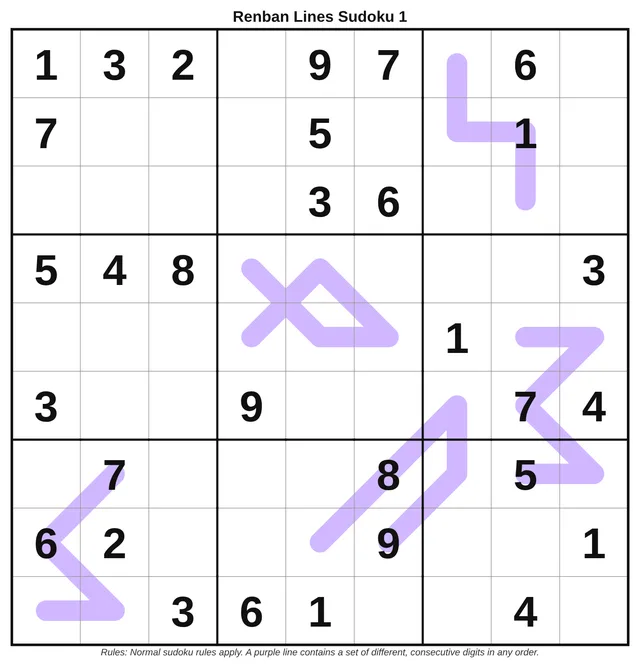
- Renban: a purple line holds a set of different, consecutive digits in any order.
- Nabner: no two digits on a yellow line are equal or consecutive.
- Palindrome: a grey line reads the same in both directions.
- Entropic: any three consecutive cells hold one low (1–3), one middle (4–6) and one high (7–9) digit.
- Modular: any three consecutive cells hold one digit from each of {1,4,7}, {2,5,8}, {3,6,9}.
- Zipper: digits the same distance from the centre add up to the centre digit.
- Region Sum: every box segment of a line has the same sum.
- Between: digits on the line are strictly between the two circled end digits.
Dot and sign variants
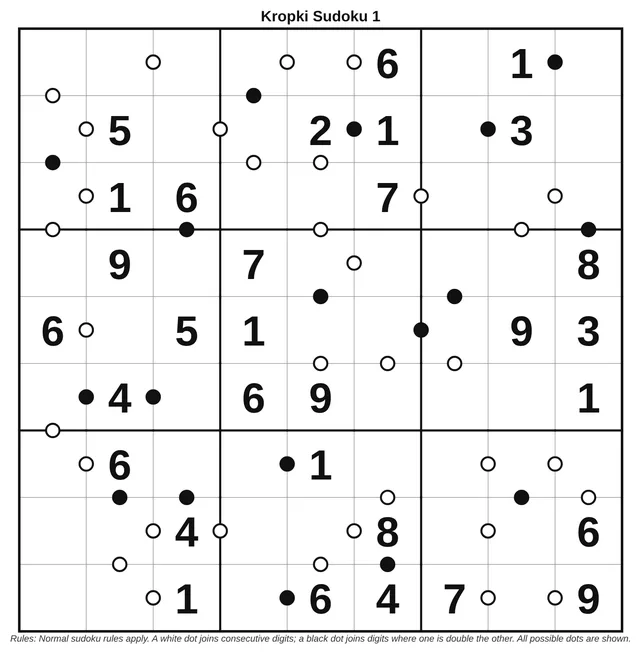
- Kropki: a white dot joins consecutive digits; a black dot joins digits where one is double the other. All possible dots are shown.
- XV: an X joins digits that add up to 10; a V joins digits that add up to 5. All possible marks are shown.
- Consecutive: a bar joins consecutive digits; no bar means not consecutive.
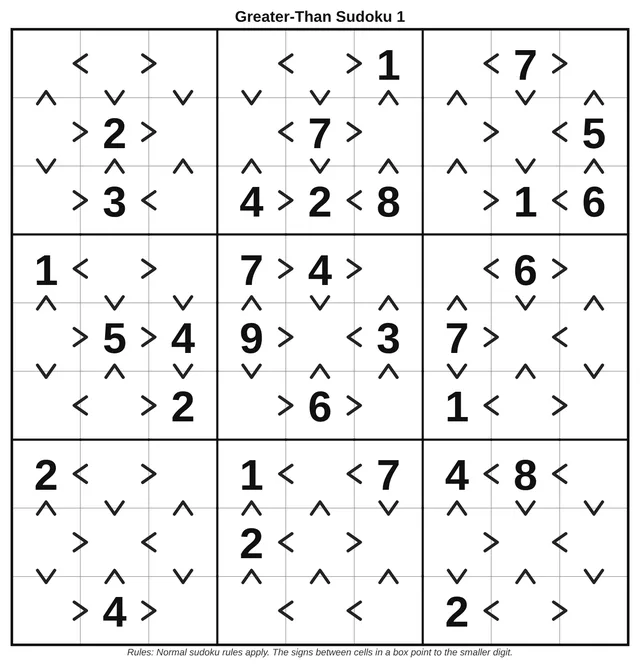
- Greater-Than: signs between cells in a box point to the smaller digit.
- Fortress: a digit in a grey cell is larger than its orthogonal neighbours.
- Quadruple: digits in a small circle appear in the four cells around it.
Outside-clue variants
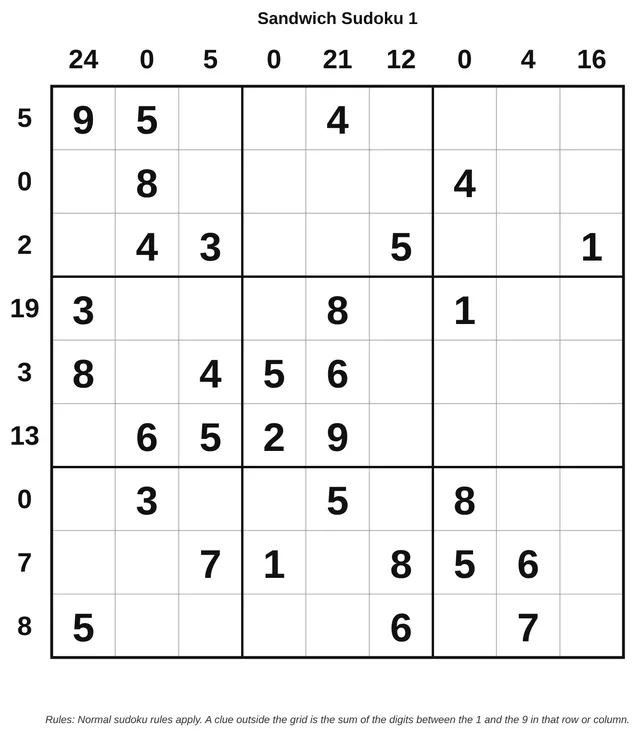
- Sandwich: the clue is the sum of the digits between the 1 and the 9 in that row or column.
- X-Sums: the clue is the sum of the first X digits, where X is the first digit seen from that side.
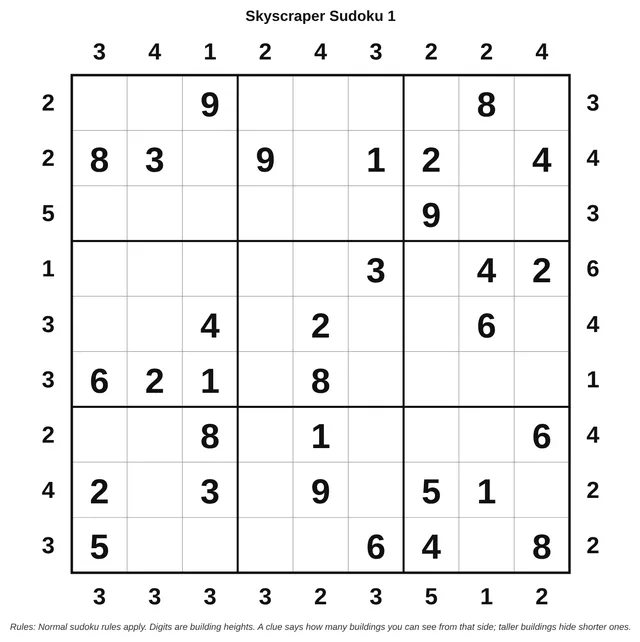
- Skyscraper: digits are building heights; the clue counts how many buildings are visible from that side.
- Little Killer: an arrow clue gives the sum of an entire diagonal; digits may repeat.
- Frame: the clue is the sum of the three nearest digits in that row or column.
Which variant should students try first?
| First variant | X-Sudoku or Even-Odd — one small extra rule |
|---|---|
| Addition practice | Killer, Arrow, Little Killer, Frame |
| Number relationships | Kropki (doubles and neighbours), XV (bonds to 5 and 10), Greater-Than |
| Ordering and logic | Thermo, Renban, Skyscraper |
| Challenge seekers | Sandwich, X-Sums, Entropic, Region Sum |
Matching a variant to a skill turns a puzzle into targeted practice: XV sudoku before a lesson on number bonds, Kropki before doubling, Killer before missing-addend problems.
How variants change the way you think
In classic sudoku, almost every deduction is about placement: “where can the 5 go in this row?” Variants add relationships between cells. Thermo and Greater-Than sudoku are about order, so you reason with minimums and maximums. Killer, Arrow and Sandwich are about sums, so you reason with combinations and totals. Kropki and XV are about pairs of digits, so you reason with relationships like “consecutive” or “adds to ten”. That is why variants are so useful in teaching: each one exercises a different kind of mathematical thinking with the same familiar grid.
Tips for solving any new variant
- Read the rule twice and find the one new idea it adds.
- Look first at the clue with the fewest possibilities: the smallest cage, the longest thermometer, the extreme outside clue.
- Combine the new rule with normal sudoku logic — most breakthroughs come from both together.
- Use pencil marks for candidates and erase as you go.
Make your own variant worksheets
All 33 variants are in the full-version Sudoku Variety Studio: choose a variant and difficulty, print the rule under each grid, add an answer key, or build a mixed book with the Variety option so every page brings a new rule.
Create your own puzzles in minutes
Unique solutions · answer keys · US Letter, A4 & KDP sizes · PDF, PNG, SVG, PPTX
Start your free day →Frequently asked questions
What is the most popular sudoku variant?
Killer sudoku, followed by X-Sudoku, Jigsaw and Thermo.
What is the easiest sudoku variant?
X-Sudoku and Even-Odd add one simple rule and are good first variants.
What is a thermo sudoku?
A sudoku with thermometer shapes; digits must strictly increase from the bulb along the thermometer.
What are Kropki dots?
White dots join consecutive digits and black dots join digits where one is twice the other.
How does sandwich sudoku work?
Each outside clue is the sum of the digits sandwiched between the 1 and the 9 in that row or column.
Do sudoku variants have unique solutions?
Well-made ones do. Every puzzle from the Sudoku Variety Studio is checked by a solver and has exactly one solution.
Summary
Each sudoku variant adds a single new rule — a diagonal, a cage, a line, a dot or an outside clue — and with it a new way of thinking. Start with X-Sudoku or Even-Odd, match variants to the skills you teach, and print the rule under every grid so students can focus on reasoning.
More puzzle guides for teachers
We build math worksheets, puzzle makers, answer keys and classroom tools for teachers, tutors and homeschool parents, and keep these guides up to date.