Killer Sudoku: Rules, Strategies and Printable Puzzles for Students
Killer sudoku combines sudoku logic with addition, which makes it one of the best puzzles for math class. Instead of (or as well as) given digits, the grid is divided into dashed cages, each with a small sum. Students must find digits that add up to the sum without repeating — real number-fact practice wrapped in a puzzle. Here are the rules, the key combinations, the strategies that matter and how to print killer sudoku for every level.
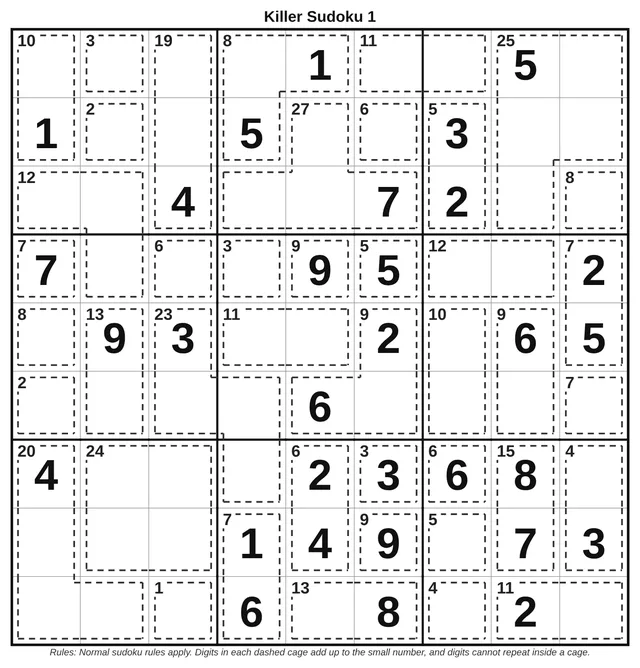
Killer sudoku rules
- Normal sudoku rules apply: each row, column and box contains every digit once.
- The grid is covered by cages drawn with dashed lines. The small number in the corner is the cage sum.
- The digits inside a cage add up to that sum.
- Digits cannot repeat inside a cage.
Cage combinations to know by heart
Some cages have only one possible set of digits. Recognising them is the first big step:
| 2 cells = 3 | 1 + 2 |
|---|---|
| 2 cells = 4 | 1 + 3 |
| 2 cells = 16 | 7 + 9 |
| 2 cells = 17 | 8 + 9 |
| 3 cells = 6 | 1 + 2 + 3 |
| 3 cells = 7 | 1 + 2 + 4 |
| 3 cells = 23 | 6 + 8 + 9 |
| 3 cells = 24 | 7 + 8 + 9 |
| 4 cells = 10 | 1 + 2 + 3 + 4 |
| 4 cells = 30 | 6 + 7 + 8 + 9 |
Students can build this table themselves: it is a lovely investigation into partitions of numbers and why the smallest and largest sums are unique.
The rule of 45
Every row, column and 3×3 box of a 9×9 sudoku contains 1 to 9, which add up to 45. If the cages inside a box add up to 41 except for one cell that sticks out of a cage, that cell must be 45 − 41 = 4. This “innie / outie” idea is the most powerful killer sudoku technique, and it is pure arithmetic reasoning. For 6×6 grids the total of each row is 21, and for 4×4 grids it is 10.
Step-by-step strategy for students
- Fill single-cell cages — the sum is the digit.
- Find cages with one possible combination (see the table) and note the digits.
- Use normal sudoku logic: a digit already in a row cannot appear again in that row.
- Apply the rule of 45 to boxes, rows and columns.
- Use pencil marks for the possible digits in each cage and eliminate as you go.
- Check every finished cage: correct sum, no repeats.
Killer sudoku by level
| Ages 7–9 | 4×4 killer, Easy — sums up to 7, many givens |
|---|---|
| Ages 9–11 | 6×6 killer, Easy to Medium |
| Ages 11–13 | 9×9 killer, Medium to Hard |
| Experienced solvers | 9×9 killer, Extreme — often no given digits at all |
In the Sudoku Variety Studio, choose Killer, then the grid size and one of five difficulty levels. At Extreme, every digit that can be removed is removed, so many puzzles are solved from the cages alone.
Why killer sudoku belongs in math class
Killer sudoku practises addition facts, missing addends, partitions and estimation (“can three different digits make 24?”) in a context where students want to get it right. It also introduces algebraic thinking: an unknown cell inside a known total is exactly the idea behind solving x + 41 = 45. Use a 6×6 killer as a warm-up before lessons on number bonds, fact families or simple equations, and follow up with a practice page from the math worksheet generator.
A worked example
Suppose a two-cell cage with sum 3 sits in the top-left box. The only possible digits are 1 and 2, so no other cell in that box can be 1 or 2. Next to it, a three-cell cage with sum 24 must be 7, 8 and 9. In the same box, the remaining cells must therefore use 3, 4, 5 and 6. If the box also contains a two-cell cage with sum 7, that cage can only be 3 + 4 (because 1 + 6 and 2 + 5 would use digits that are taken or impossible), and the last two cells must be 5 and 6. With just three cages and the rule of 45 in mind, most of a box can be pinned down — before a single given digit is used.
Common mistakes students make
| Repeating a digit in a cage | Remind them: digits never repeat inside a cage, even if the cage spans two boxes. |
|---|---|
| Forgetting normal sudoku rules | Cages add a rule; they do not replace the row, column and box rules. |
| Guessing combinations | List every possible set for a cage, then cross out the impossible ones. |
| Ignoring the totals | Use 45 (9×9), 21 (6×6) or 10 (4×4) for every row, column and box. |
Related variants
Little Killer sudoku puts sums outside the grid for whole diagonals, Arrow sudoku asks for digits along an arrow to add up to the circle, and Sandwich sudoku gives the sum of the digits between 1 and 9 in each row and column. All three are in the Sudoku Variety Studio and explained in 33 sudoku variants explained.
Create your own puzzles in minutes
Unique solutions · answer keys · US Letter, A4 & KDP sizes · PDF, PNG, SVG, PPTX
Start your free day →Frequently asked questions
What are the rules of killer sudoku?
Normal sudoku rules apply, digits in each dashed cage add up to the cage sum, and digits cannot repeat within a cage.
What is the rule of 45 in killer sudoku?
Each row, column and box of a 9×9 sudoku adds up to 45, so a missing cell can be found by subtracting the known cage sums from 45.
Can digits repeat in a killer sudoku cage?
No. Digits in a cage are always different.
Is killer sudoku harder than normal sudoku?
It can be, but with many givens and small grids it is suitable for children from about seven years old.
Can I print killer sudoku for kids?
Yes. The Sudoku Variety Studio makes killer sudoku in 4×4, 6×6 and 9×9 with five difficulty levels and answer keys.
Does a killer sudoku need given numbers?
Not always. The cage sums alone can be enough for a unique solution, which is common at Extreme difficulty.
Summary
Killer sudoku is sudoku plus addition: learn the unique cage combinations, use the rule of 45, eliminate with pencil marks, and start children on small grids. It is one of the most effective puzzles for turning number facts into reasoning.
More puzzle guides for teachers




We build math worksheets, puzzle makers, answer keys and classroom tools for teachers, tutors and homeschool parents, and keep these guides up to date.