Printable Sudoku for Kids: 4×4 and 6×6 Puzzles and How to Teach Them
Children can start sudoku much earlier than most adults think. A 4×4 grid with four symbols is simple enough for a five- or six-year-old, yet it uses the same logic as the 9×9 puzzles in the newspaper. In this guide you will find which size to use at each age, a five-step sequence for teaching sudoku, strategies children can actually use, and how to print kid-friendly sudoku with pictures, stories and answer keys.
Why sudoku is great for children
Sudoku asks children to notice what is missing, to hold several facts in mind and to make a decision only when it is certain. Those are early reasoning skills that support reading comprehension and mathematics alike. Because each puzzle has one correct answer, children get clear feedback, and because the puzzle needs no arithmetic, even students who struggle with numbers can succeed — which often changes how they see themselves in math class.
Which size for which age?
| Ages 4–6 | 4×4 with pictures or colors instead of numbers, many givens |
|---|---|
| Ages 6–8 | 4×4 with digits 1–4, then 6×6 Easy |
| Ages 8–10 | 6×6 Medium, first 9×9 Easy puzzles |
| Ages 10+ | 9×9 Easy to Medium, then simple variants such as X-Sudoku and Even-Odd |
A five-step sequence to teach sudoku
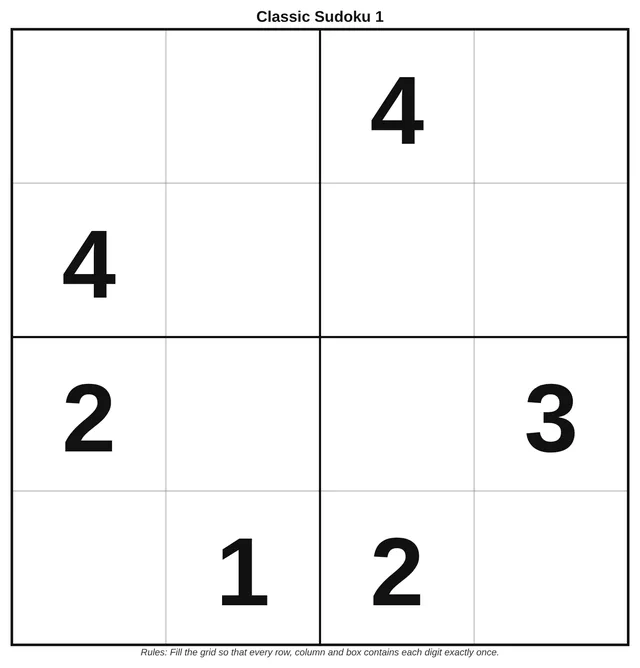
- Explain one rule. Every row, column and box contains each symbol once. Show it with a finished 4×4 grid and let children check it.
- Solve together. Project a 4×4 puzzle and think aloud: “This row has a 1, a 2 and a 4. What is missing?”
- Pairs practice. Children solve an Easy 4×4 in pairs. One places the digit, the other must agree and say why.
- Independent practice. Give a page of four 4×4 puzzles. Early finishers check with the answer key.
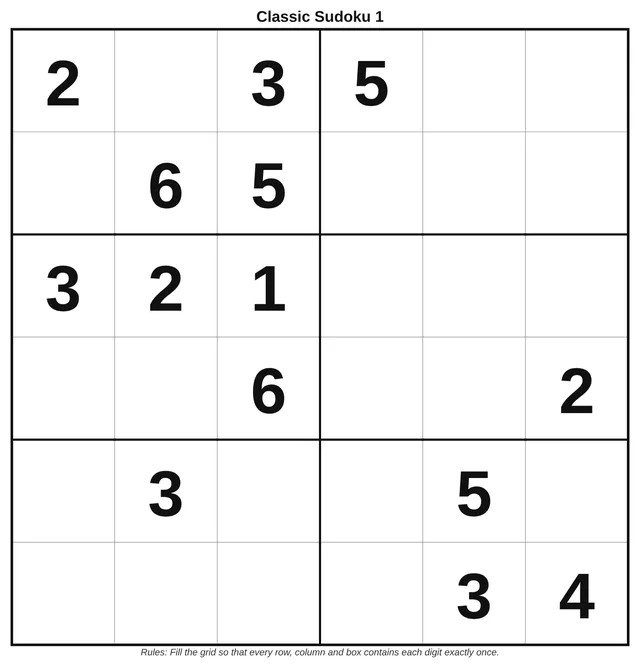
- Level up. When three puzzles in a row are solved without help, move to 6×6, then to Medium.
Strategies children can use
- Find the almost-full line. Look for a row, column or box with only one empty square — the missing symbol goes there.
- Count what is there. List the symbols already in a row and say which ones are missing.
- Cross-hatching. Pick one symbol and slide your finger along every row and column where it already appears; the square it can still go in shows up.
- Pencil marks. Older children write small candidate numbers in a corner and erase them as they go.
- Check, don’t guess. If a number “might” go in two places, leave it and look somewhere else.
Picture sudoku and story sudoku
For pre-readers, replace digits with pictures. In the Sudoku Variety Studio, choose Symbols → Custom and type an emoji or word for each digit, or upload your own images — fruit, animals, class mascots or letters you are learning. Switch on Story mode and every puzzle gets a short mission (“Help Captain Luna restore the star map!”) that turns the page into an adventure. Children who would not try “a math page” happily try “a mission”.
Moving beyond classic sudoku
Once children are confident, small variants keep things fresh: X-Sudoku adds the diagonals, Greater-Than sudoku adds comparison signs (great practice for < and >), Killer sudoku adds simple addition in cages, and Even-Odd sudoku practices odd and even numbers. All of them exist in 6×6, and several in 4×4. Our guide to killer sudoku shows how to introduce cages step by step.
A worked example on a 4×4 grid
Imagine the top row reads 1 _ 4 _ and the second column already contains a 3 lower down. The top row is missing 2 and 3. The empty square in column two cannot be 3, because that column already has one — so it must be 2, and the last square in the row is 3. Walk children through two or three examples like this, always finishing with “how do we know?”. Then ask them to invent the explanation for the next square themselves. Within a few sessions they will be explaining moves you did not point out.
How to keep children motivated
Keep a simple progress chart: each solved puzzle earns a sticker, and moving up a size earns a certificate. Mix formats so practice never feels repetitive — a picture sudoku on Monday, a story mission on Wednesday, a 6×6 race in pairs on Friday. Let children choose between two difficulty levels; choice increases effort. Finally, praise the reasoning, not just the finished grid: “I like how you checked the column before writing that 4.”
Classroom and home tips
- Laminate a few 4×4 pages and use dry-erase markers for daily practice.
- Use one large grid per page for young children; small grids frustrate small hands.
- Celebrate the first solved 6×6 and the first 9×9 — they are real milestones.
- Send a puzzle home each week with the answer key so families can play together.
- Keep sessions short: five to ten minutes of focused solving beats a long, tired session.
Free printables: our free puzzle makers include a classic sudoku maker with 4×4, 6×6 and 9×9 and picture sudoku. For 33 variants, story mode and books, use the full-version Sudoku Variety Studio.
Create your own puzzles in minutes
Unique solutions · answer keys · US Letter, A4 & KDP sizes · PDF, PNG, SVG, PPTX
Start your free day →Frequently asked questions
At what age can children start sudoku?
Around four to five years old with 4×4 picture sudoku, and around six with digits 1–4.
Is sudoku good for kids’ brains?
Sudoku builds logical reasoning, concentration, working memory and perseverance, without needing arithmetic.
What is the easiest sudoku for kids?
A 4×4 grid with many given symbols, ideally with pictures for younger children.
How do I explain sudoku to a child?
Use one rule: each row, column and box has every symbol once. Show a finished grid, then solve one together while thinking aloud.
Should children guess in sudoku?
No. Teach them to place a symbol only when they can explain why it must go there.
Can I print sudoku with pictures?
Yes. In the Sudoku Variety Studio, choose custom symbols and type emoji or upload images for each digit.
Summary
Start with 4×4 picture or digit puzzles, solve the first ones together, teach a handful of real strategies and move up one size or level at a time. With pictures, stories and answer keys, sudoku becomes a short, joyful reasoning routine for any age.
More puzzle guides for teachers
We build math worksheets, puzzle makers, answer keys and classroom tools for teachers, tutors and homeschool parents, and keep these guides up to date.