Printable I Have, Who Has? Cards: How to Make Them and Play with Your Class
I Have, Who Has? is one of the simplest whole-class games a teacher can run: every student holds a card, one student reads a question, and whoever has the answer reads the next question. In a few minutes the whole class has practised twenty or thirty facts — and everyone had to listen to every single one. This guide explains how the game works, how to play it smoothly with any group, and how to make printable I Have, Who Has? cards for any skill in minutes with the card maker in your OnlineMathWorksheet account.
How the game works
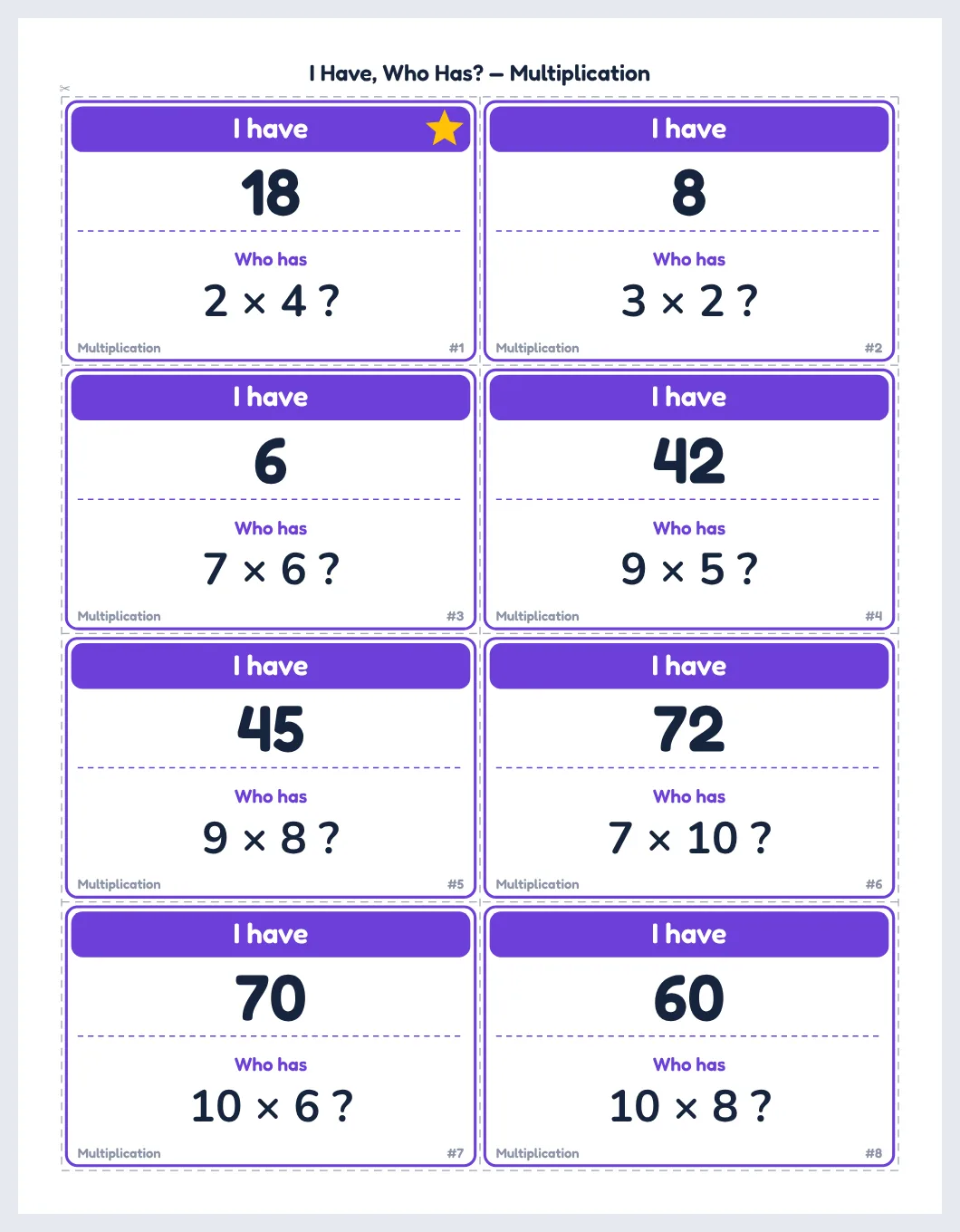
Each card has two parts. The top says “I have …” with an answer, and the bottom says “Who has …?” with a question. The student with the star card starts by reading the question on their card: “Who has 7 × 6?” The student whose card says “I have 42” stands up, reads it, and then reads their own question: “Who has 9 × 3?” The game continues until it comes back to the first card.
The cards form a closed chain, so every card is used exactly once and nobody can be skipped. Because every answer in the deck is different, there is never confusion about who should answer.
Why I Have, Who Has? works so well
- Everybody is involved. Every student must listen to every question, because the next one might be theirs.
- Many repetitions in little time. A 30-card game takes 5 to 8 minutes and covers 30 facts.
- Mental maths under friendly pressure. Students calculate each answer silently to check if it is on their card.
- Speaking and listening. Students read aloud clearly and follow a sequence.
- Easy to repeat. Time the class and try to beat the record the next day — students love it.
How to make printable cards in minutes
- Choose a skill. The card maker has 13 maths skills: one more, one less, ten more, doubles, halves, addition, subtraction, addition and subtraction, multiplication (one table or mixed tables), division, multiplication and division, square numbers and all four operations.
- Choose the range — for example addition up to 20, the table of 7, or mixed tables up to 12.
- Set the number of cards from 6 to 60. Match it to your class size, or make one card per student plus a few extra for strong students.
- Choose the layout: 4, 6, 8 or 9 cards per page.
- Export as PDF, PNG, SVG or PowerPoint and print.
Some skills have a natural limit: a single times table has only 12 different answers, so the maker stops at 12 cards and explains why. Addition, subtraction and mixed operations go all the way to 60.
Your own cards for any subject
Choose Custom cards and type one card per line as question = answer:
| Maths | 3/4 of 20 = 15 · 25% of 80 = 20 · 2³ = 8 |
|---|---|
| Language | Opposite of hot = cold · Plural of child = children |
| Science & geography | H₂O = water · Capital of Algeria = Algiers |
The maker builds the chain for you and warns you if two answers are the same, because duplicate answers would stop the game.
Card design options
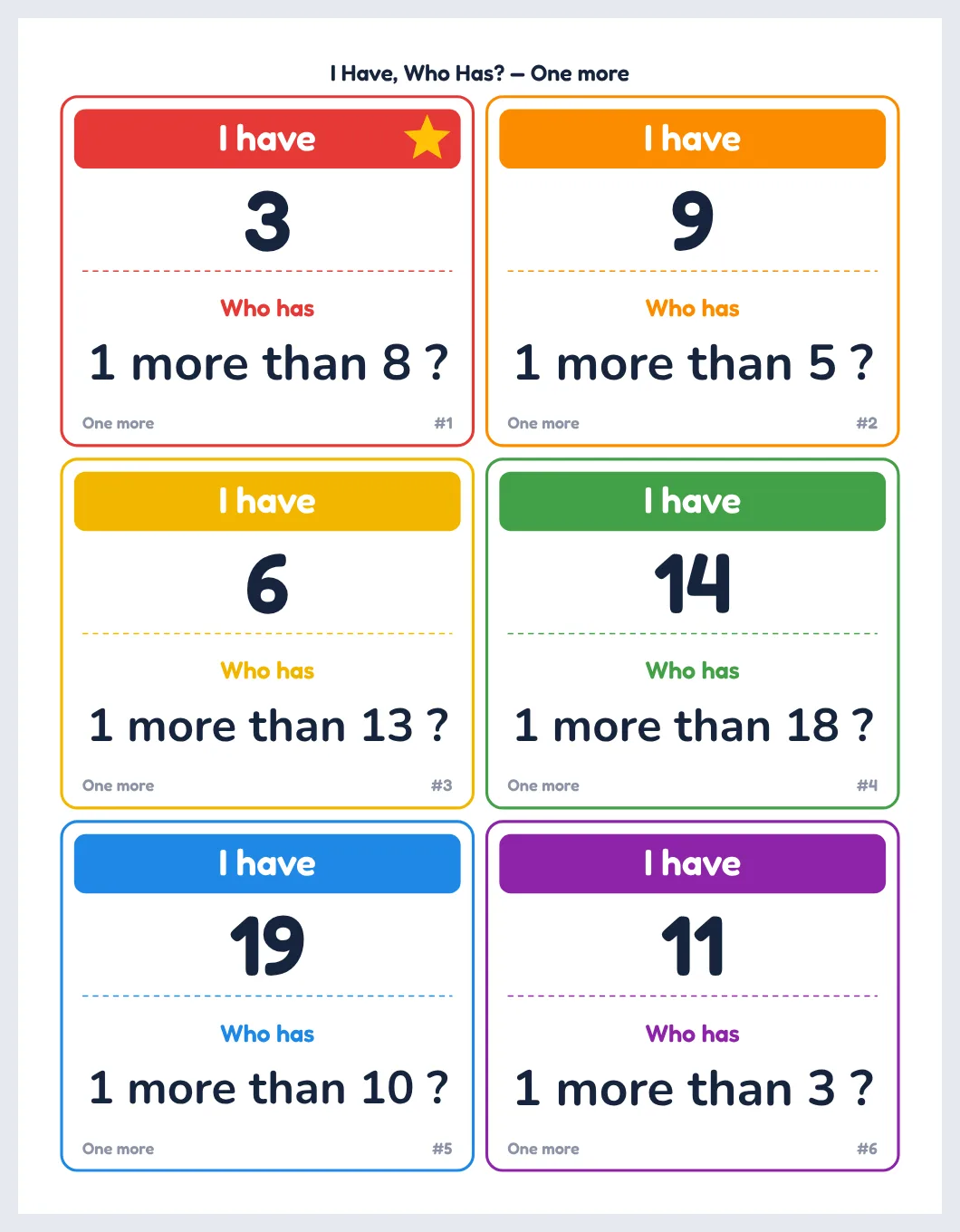
- Colours: 8 colour themes plus a rainbow option where every card has its own colour.
- Style: colour band, soft fill or ink saver.
- Card border: none, solid, dashed or dotted, with thickness, corner roundness and colour (same as the card or your own).
- Cutting: dashed cutting lines or separate cards with space between them.
- Details: star on the first card, card numbers, deck name on each card, answer size, and your own wording for “I have” and “Who has”.
- Page: optional title, name and date lines with their own size, page border (style, line, corners, colour), page size and margins.
The teacher call-order page
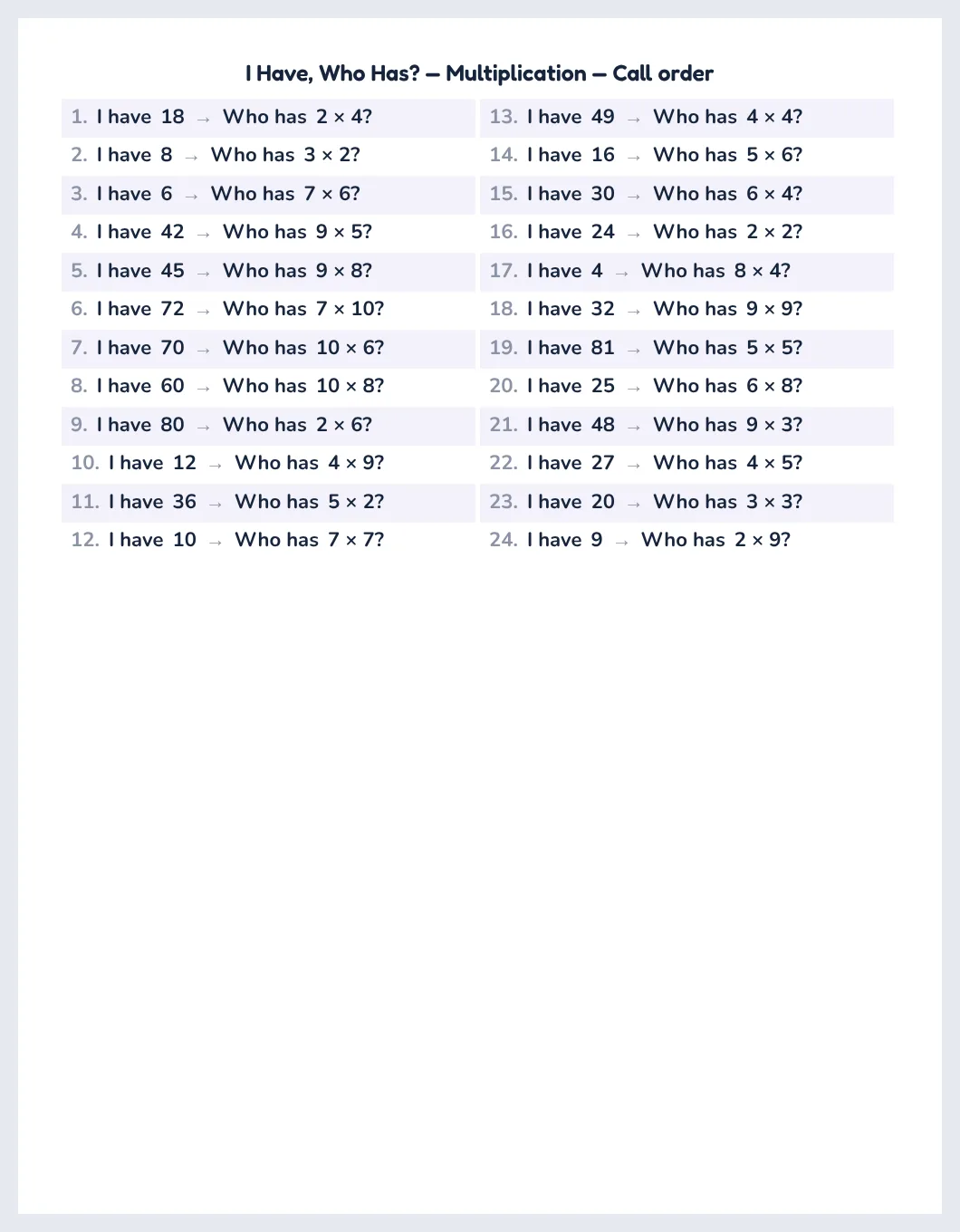
After each deck the maker adds a page that lists every card in playing order: card 1 has 18 and asks for 2 × 4, card 2 has 8 and asks for 3 × 2, and so on. Keep it in your hand during the game. If a student hesitates, you know immediately which answer comes next, and you can see at a glance which facts caused trouble.
Tips for playing smoothly
- Model first. Play the first round with the cards face up on the board.
- Give thinking time. Ask students to work out the answer to their own question before the game begins.
- More cards than students? Give two cards to confident students. Fewer? Remove cards before printing by lowering the number — the chain is rebuilt automatically.
- Time it. Write the class time on the board and try to improve it.
- Laminate the cards and keep each deck in an envelope with its call-order page.
- Build a library. Use “One-click pack” to make all the times tables from 2 to 10 at once, or a kindergarten, grade 1, grade 2 or grade 4 pack.
Make your own printable activities in minutes
Answer keys · US Letter, A4 & KDP sizes · PDF, PNG, SVG, PPTX
Start your free day →Frequently asked questions
What is I Have, Who Has?
A whole-class game in which every student holds a card with an answer (“I have…”) and a question (“Who has…?”). Students read in a chain until the game returns to the first card.
How many cards do I need?
One per student is ideal. The maker creates 6 to 60 cards, so you can match any class.
Can I make cards for subjects other than maths?
Yes. Choose Custom cards and type one question = answer pair per line.
What if a card has no answer in the deck?
That cannot happen: the maker builds a closed chain in which every answer appears exactly once.
How many cards fit on a page?
You can choose 4, 6, 8 or 9 cards per page.
Is there an answer key?
Yes. A teacher call-order page lists every card in playing order after each deck.
Summary
I Have, Who Has? is a fast, inclusive game for practising facts, and it takes only minutes to prepare with the card maker: choose a skill or type your own cards, set the number of cards, pick a design and print. The teacher call-order page keeps the game running smoothly.
More puzzle guides for teachers
We build math worksheets, puzzle makers, answer keys and classroom tools for teachers, tutors and homeschool parents, and keep these guides up to date.