Estimation Worksheets

Estimation teaches students to check whether answers make sense. Students round each number first and then calculate.
📥 Download the free estimation worksheet (PDF) — or read on to learn how to make your own versions in seconds.
What students practice
Example worksheet and answer key
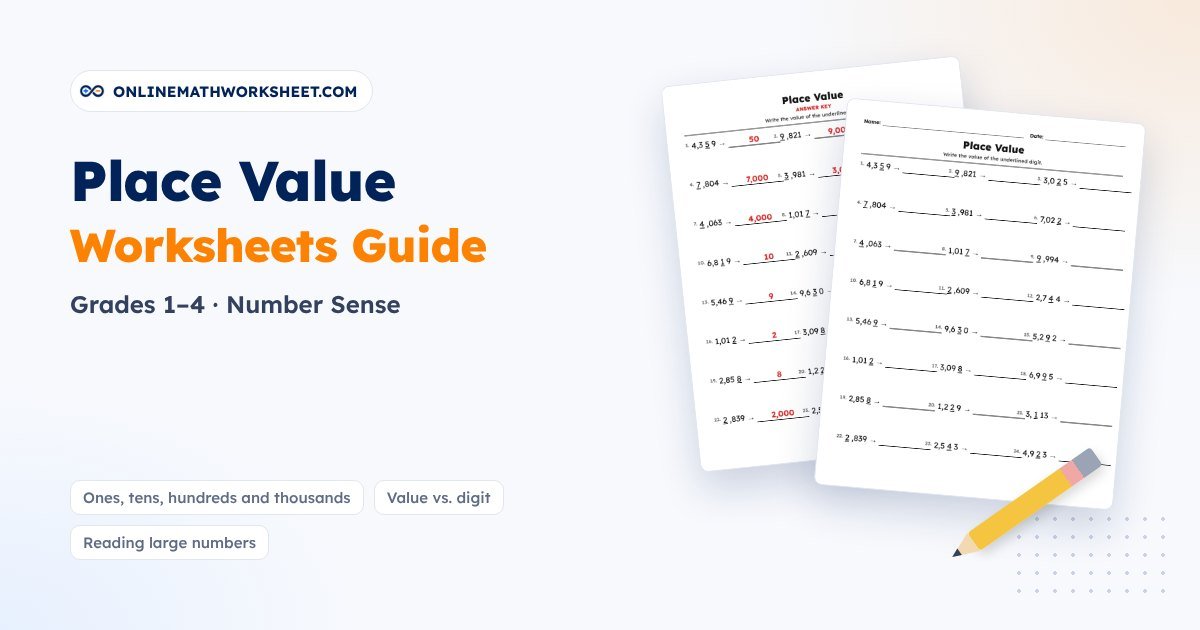
Here is an estimation worksheet made with the default settings, next to the answer key that the tool creates automatically.


How to create an estimation worksheet in 60 seconds
- Sign in to OnlineMathWorksheet (or start the free 1-day trial) and open the tool.
- In Settings → Worksheet type, choose Estimation from the Number Sense group.
- Open Problem options and adjust: Round to the nearest, Operations.
- Under Problem layout, pick the number of rows and columns (the default is 8 × 2).
- In Header, keep the title “Estimation” and the instruction “Estimate by rounding first.”, or write your own.
- Click New problems for this page until you like the set — every click creates a fresh version.
- Use Export to download a PDF with the answer key, or save the pages as PNG or JPG images.
Ready-made settings
Use these as starting points and adjust them to your class:
| Addition to nearest 10 | Round to the nearest 10, operation +. |
|---|---|
| Add & subtract to nearest 100 | Nearest 100, + and −. |
| Big numbers | Nearest 1000. |
Teaching tips
- Ask students to compare the estimate with the exact answer.
- Discuss when an estimate is “good enough” in real life.
- Practice rounding first.
Make your first estimation worksheet now
Try all 52 activities free for one day. No card needed.
Start free →Frequently asked questions
Do the estimation worksheets come with an answer key?
Yes. Every worksheet gets a matching answer page automatically. You can include it in the PDF or hide it.
Can I make a different version for each student?
Yes. Click “New problems for this page” to generate new numbers with the same settings — as many times as you like.
Which languages are available?
The worksheet itself can be printed in English, French, Spanish or Arabic, which is handy for bilingual classes.